~ about the enneagram ~
What is the Enneagram?
The Enneagram is a model of human personality that describes nine distinct types, each defined less by outward behaviour than by an inner pattern of motivation — a core desire, a core fear, and the habit of attention that grows up around them. Its name comes from the Greek words for "nine" and "figure": the nine points are arranged around a circle and joined by lines, and that geometry is part of the idea. Each type sits between two neighbours, called wings, that colour how it expresses itself, and each is connected by lines to two other types it tends to move toward — one in growth, one under stress.
Rather than sorting people into boxes, the Enneagram tries to name the reason underneath what we do: the same action can spring from very different motives, and it is the motive the system cares about. Used well, it is a mirror for self-understanding and a vocabulary for the patterns that run quietly in the background of a life — not a verdict, and not a measure of worth.
A short history
The nine-pointed figure entered the modern West through George Gurdjieff, a spiritual teacher who, in the early twentieth century, presented it as a symbol of process and transformation within his "Fourth Way" teaching. Gurdjieff traced the symbol to ancient esoteric sources, though those origins have never been historically confirmed; in his hands it described movement and cycles, and had nothing to do with personality.
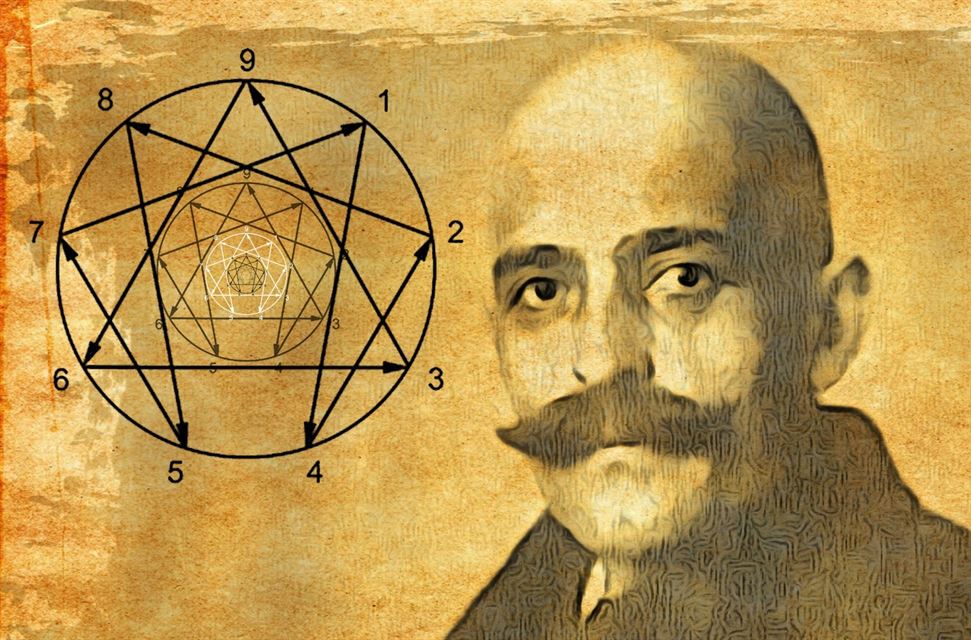
The link to personality came later. Around 1970 the Bolivian-born teacher Oscar Ichazo mapped a typology of nine "ego fixations" — together with their associated passions and virtues, echoing the classical vices — onto the points of the figure, and taught it at his Arica school. The Chilean psychiatrist Claudio Naranjo then carried the system to the United States, where he reframed it in the language of modern psychology and taught it in small study groups in California. From there it spread — through Jesuit educators, and later through popular teachers such as Helen Palmer, Don Riso, and Russ Hudson — into the widely known framework it is today.
Because so much of the modern system is a twentieth-century synthesis, it is best understood as a living tradition of insight rather than an ancient doctrine, and as a tool for reflection rather than a scientifically validated instrument. Its value lies in what it helps you notice about yourself.
How this test works
This test presents 45 statements — five for each of the nine types — and asks you to rate how true each one feels, from strongly disagree to strongly agree. The five answers for a type are added together, so every type earns a score, and the type that scores highest is taken as your primary type. Of its two neighbours on the circle, the stronger one becomes your wing; when the two are evenly matched, the result is shown as balanced instead.
The whole thing takes about eight minutes and needs no signup. Treat the outcome as a well-informed estimate and a place to begin, not a diagnosis — the reading that follows is meant to be held up against your own experience. The type that genuinely sounds like you, in its motivations and not just its surface traits, is the one worth exploring, even if it isn't the one the numbers rank first.